Real response, not guesswork
Roll, pitch, heave and acceleration are tied to loading, speed, heading and sea context.
ShipMotionIQ turns real vessel response into a living Motion Digital Twin: reusable for simulation, API access, routing workflows, cargo limits and signed voyage evidence.
What makes it different
The product is built around one asset: a vessel-specific Motion Digital Twin that improves as measured voyages arrive and can be reused outside the dashboard.
Roll, pitch, heave and acceleration are tied to loading, speed, heading and sea context.
One measured body frame lets the model resolve cargo, bridge, gangway, crane hook or moonpool points.
Similar hulls can shorten cold starts while each vessel keeps its own calibration and confidence.
Versioned model outputs can be exposed to routing, cargo, offshore and engineering workflows.
Cloud-native vessel architecture
The MVP Azure foundation is already in place. The product architecture is designed to collect maritime IoT telemetry, validate it in the cloud and turn measured voyages into versioned model updates.
The portal, IoT Hub, Cosmos DB, Storage, Key Vault and observability are provisioned for the MVP. Automated training and model registry are the next production layer as vessel data grows.
Measurement-trained motion model
Each voyage adds coverage, confidence and lineage to the vessel model, so the asset improves without turning every trip into a one-off report.
Voyages add measured roll, pitch, heave and acceleration with loading, speed, heading and sea context.
Observed response is checked against RAO assumptions, tank-test curves, class files or third-party tools.
Similar hulls can share coverage while each vessel keeps its own calibration, confidence and limits.
Planning, cargo limits, offshore workability and evidence can reuse one versioned twin.
A new hull starts with physics and sister-transfer coverage, then becomes vessel-specific as measured voyages arrive. Owners keep the model lineage visible.
Portal in action
Real portal screens — illustrative demo data — show the core loop: monitor vessels, inspect response surfaces and expose the model as a reusable asset.
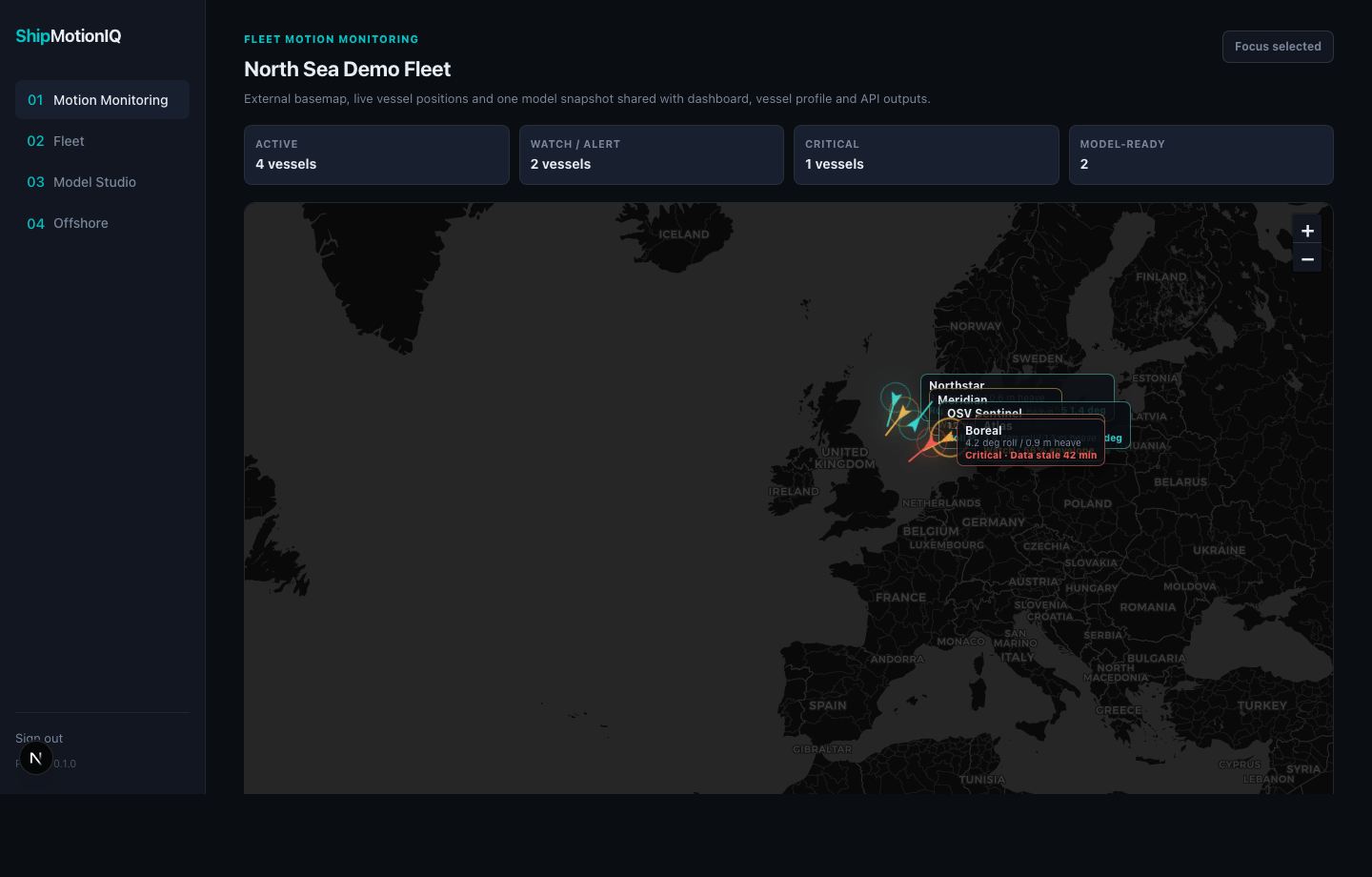
The same vessel snapshot drives map status, limits and model confidence.
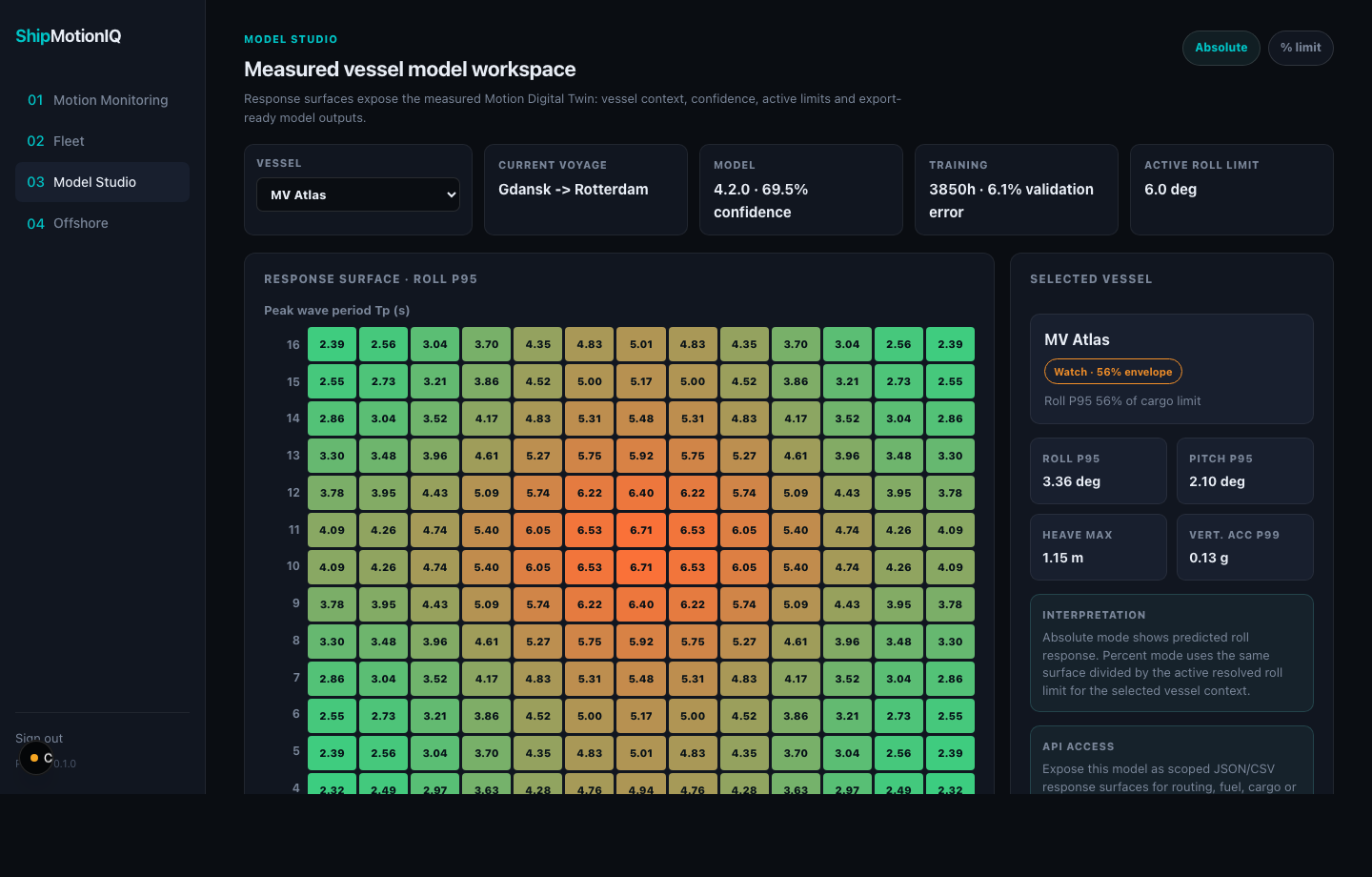
Scenario views expose the measured model instead of a one-off report.
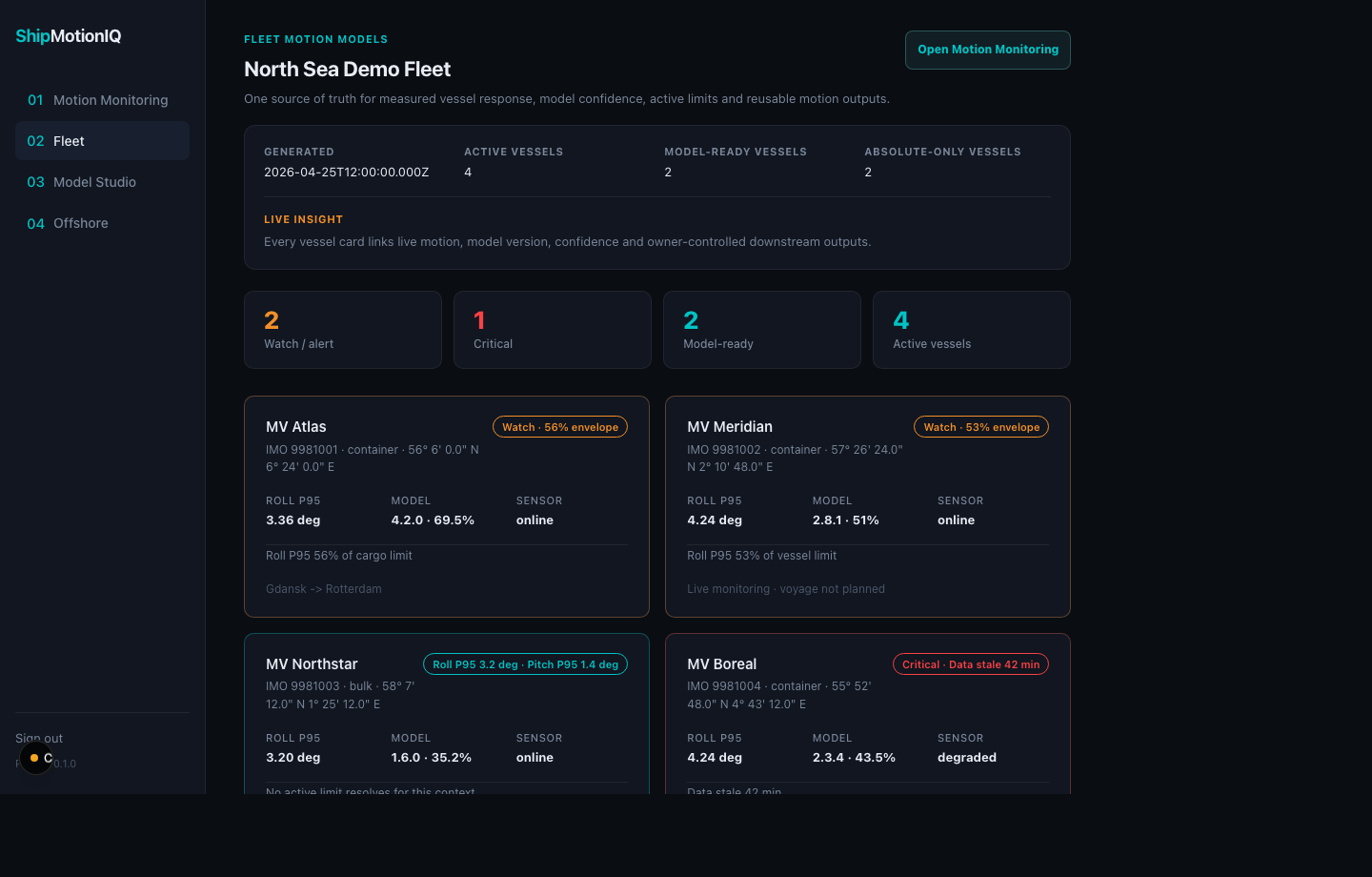
Owners see which vessels are measured, stale, limit-bound or model-ready.
Model Studio
Model Studio turns the measured digital twin into response surfaces: any heading, loading, sea state and virtual point can be compared against theory and exported.
Access layer
The portal is the operational interface. The deeper value is a versioned model that trusted teams can query, export and verify without taking ownership of raw data.
Access can be limited by vessel, model version, voyage context or vendor workflow.
External tools can request motion-aware response surfaces instead of static assumptions.
Measured-vs-theory outputs can be shared with naval architects, class or shipyards.
Selected voyages can become signed Motion Passport records with model lineage.
Signed model output
The Passport stays valuable because it carries the model version, measured coverage, loading context, active limits, observed voyage record and verification payload.
Loading condition, route, weather assumptions, learned model version and active limit versions.
Absolute motions, gaps, filtered intervals and anomalies stay tied to the same voyage context.
The final record carries version lineage and a reproducible verification payload.
Illustrative structure · voyage-specific output
Early Access
Build the first measured Motion Digital Twin, review Model Studio and expose the first controlled API/export workflow.
90-day pilot · No drydock · Edge node + portal + first model export